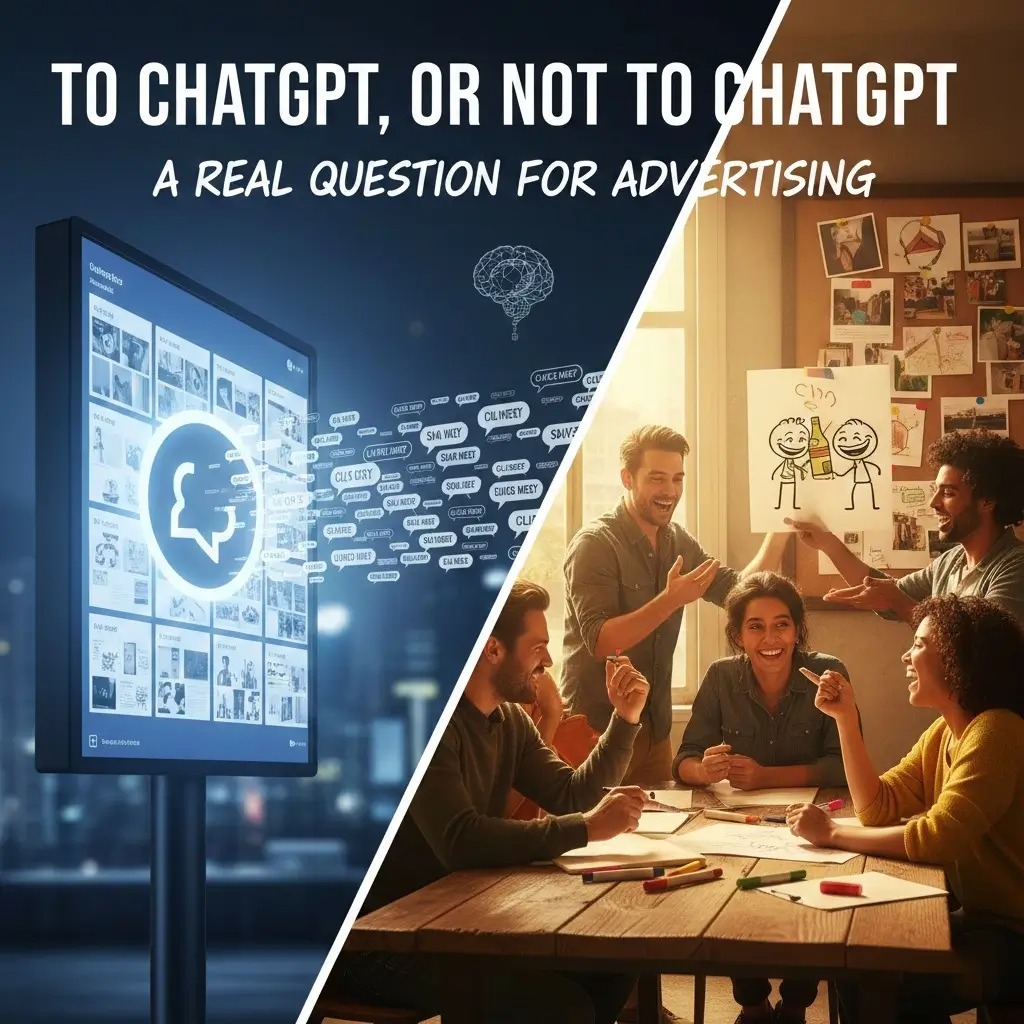
To ChatGPT, or Not to ChatGPT – A Real Question for Advertising
These days, there's one question echoing across the advertising world everywhere: Should we be using ChatGPT? Can it actually help us make better ads?
There's no denying to the fact that AI tools like ChatGPT are impressive and time saving. We add in a few words or a loose idea, and instantly we get headlines, social media posts and also presentations and scripts. For teams that are working under stringent timelines, this sounds like a lifesaver. Who wouldn't want an assistant that works 24/7?
Unfortunately, advertising is not just about writing words or curating ideas that lack empathy.
It's about understanding people—what they care about, what connects with their daily life, and what grabs their attention. That's why some ads resonate in our memory, while others fade into the feed. Think of Fevicol's simple yet relative ads that have been making us smile for decades, or Swiggy's quirky late-night delivery campaigns that feel like a friend who just gets you at midnight. These aren't just well-written; they connect with us.
This is exactly where AI falls short and thus loses its connect with the advertising world.
Change has always been the only constant and this principle of life is also implied in the advertising world. Audience is always on the lookout for innovation and change. The AI tools do not attend to the subtle cultural shifts, inside jokes or the vibes of the environment. This kind of conceptualisation comes from human insight and creativity only.
This surely does not mean that AI is not useful.
Agencies, today use ChatGPT to create the first draft or generate basic flow of the ads. These form as the basic framework which could be modified and help the teams to stay focused on the big picture of the creative.
But here's the catch: If everyone starts using AI the same way, everything will start to sound too similar. That uniqueness will get lost in the crowd of AI. It risks getting lost in a sea of "smart" but soulless content. The smart agencies today are well aware about this and they use AI carefully, as a support tool, not a substitute for human creativity.
The most appealing ads come from creative minds who understand the pulse of their audience and have the ability to connect and resonate their stories. Advertising is not just about selling – it's the art of connecting to your audience without being physically present, the art of building trust and making your audience feel that you belong amongst them.
To conclude, we can surely say that using ChatGPT as an alternative could be considered but with caution.
The human element and the personalised touch should not be missed. AI could be used to move faster, explore more broader platforms but the final message crafted must be human monitored and created.
Great advertising connects, surprises, and makes you think. And for now, that's still something only humans can do best.
Also Read: